 English
 Español
 عربى
عربىBT-1082 Good Price Stainless steel Bathroom 130Mm Square Shower 304 Stainless Steel Floor Drain
Cat:108mm Series
The BT-1082 Good Price Stainless Steel Bathroom 130mm Square Shower 304 Stainless Steel Floor Drain
See DetailsBecome your trusted floor drain product partner and supplier in China.
Tel: +86-576-87422105, Email: [email protected]


The BT-1082 Good Price Stainless Steel Bathroom 130mm Square Shower 304 Stainless Steel Floor Drain
See Details
Product Name: floor drain Item No.: BT-1084 Size: 130*130mm Outlet: 2"-11.5 NPSM
See Details
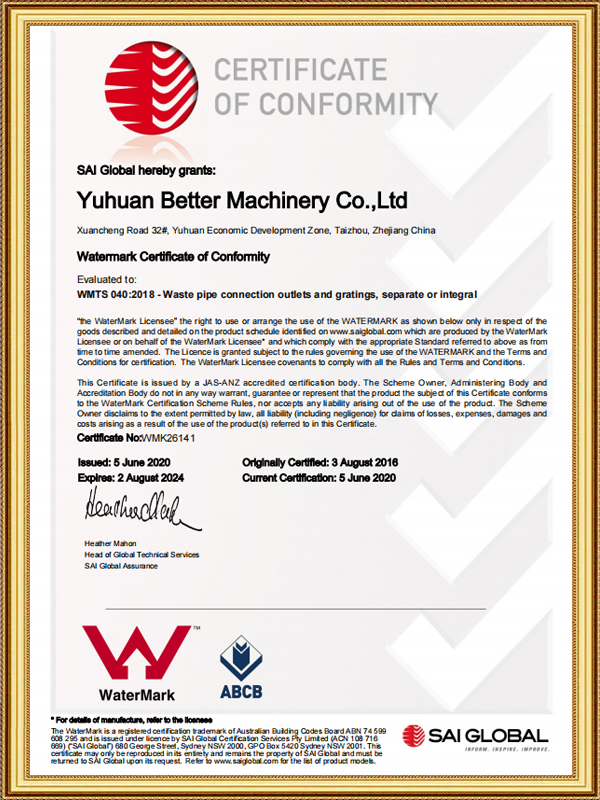
Yuhuan Better Machinery Co., Ltd. is a professional factory for 108mm Series Stainless Steel Floor Drains Suppliers and 108mm Series Stainless Steel Floor Drains Suppliers. The company is Located in yuhuan which is a garden city on the shore of the east china sea. We have moved in a new factory since the year 2012, which is more than 10000 square meters. Since its establishment in1990, we adhere to the management concept of "the enterprise is improved by absorption and the achievement is derived from quality," and always dedicate ourselves to developing the enterprise of stampings, linear drain, floor drain, and sheet metal. Now, we have integrated the product design, development, and production.
Stainless steel floor drains have become increasingly popular in recent years due to their durability, reliability, and ease of maintenance. The 108mm series stainless steel floor drains, in particular, have gained a reputation for being an excellent choice for a wide range of applications.
Square Floor Drains: Square floor drains are a popular choice for applications where aesthetics are important. They have a sleek and modern appearance that can enhance the overall look of any space. Square floor drains are also available in various sizes, making them suitable for a wide range of applications.
Linear Floor Drains: Linear floor drains are designed to be installed against walls or in the center of the floor. They are commonly used in showers, locker rooms, and other wet areas. Linear floor drains have a long, narrow design that allows them to efficiently remove water from large surfaces.
Round Floor Drains: Round floor drains are a popular choice for applications where space is limited. They have a compact design that allows them to be installed in tight spaces. Round floor drains are commonly used in bathrooms, kitchens, and other areas where water needs to be efficiently drained.
Trench Drains: Trench drains are designed to be installed in areas where a significant amount of water needs to be removed, such as industrial settings or outdoor areas. They have a long, narrow design that allows them to efficiently remove large volumes of water.
Floor Sink Drains: Floor sink drains are designed to be installed in commercial kitchens and other areas where large volumes of water need to be removed. They are typically deeper than other types of floor drains, allowing them to hold more water before needing to be emptied.
Cleanout Drains: Cleanout drains are designed to allow for easy access to the plumbing system for maintenance or repair. They are typically installed in areas where there is a higher risk of clogs or blockages, such as commercial kitchens or industrial settings.
Shower Drains: Shower drains are designed to be installed in shower areas. They are typically smaller than other types of floor drains and have a removable grate that allows for easy cleaning and maintenance.
Determine the location: Choose the location where the drain will be installed. It should be at a low point in the floor where water will naturally flow towards it.
Prepare the surface: The surface where the drain will be installed must be clean and level. Make sure that there are no obstructions or debris that may interfere with the installation.
Cut the hole: Using a hole saw or a jigsaw, cut a hole in the floor where the drain will be installed. Make sure that the hole is the correct size for the drain.
Install the drain body: Place the drain body into the hole and secure it in place using screws. Make sure that the drain body is level and flush with the floor surface.
Install the waterproofing membrane: Apply a waterproofing membrane around the edge of the drain body. This will prevent water from leaking through the joint between the drain body and the floor.
Install the grate: Place the grate onto the drain body and secure it in place using screws. Make sure that the grate is level and flush with the floor surface.
Connect the piping: Connect the piping to the drain body using the appropriate fittings. Make sure that the piping is properly aligned and secured.
Test the drain: Pour water into the drain to test it for leaks and proper drainage. Make sure that water flows smoothly and does not leak from any joints.
Finish the installation: Once the drain is tested and proven to be functional, finish the installation by filling any gaps around the drain body with sealant.
Copyright © Yuhuan Better Machinery Co., Ltd. All Rights Reserved.


 +86-576-87422105
 +86-576-87422322
 Xuancheng rd 32#, Yuhuan Economic Development Zone, Zhejiang, China